Compressed air is often the single most expensive utility in a plant per unit of useful work, and in most facilities it is also the only one nobody meters.
The utility hiding in plain sight
Compressed air feels free because it comes out of a pipe, but it is anything but. Generating it is energy-intensive and inefficient: only a fraction of the electricity a compressor draws ends up as useful work at the tool, and the rest leaves as heat. That makes air one of the costliest ways to move energy around a plant. Yet while facilities meter electricity and increasingly meter gas and water, compressed air usually runs completely unmeasured from the compressor room to the point of use.
You cannot manage air you cannot measure
Without flow data, the air system is a black box. You know the compressor runs, and you know the power bill, but you cannot see where the air actually goes, which machines are heavy, how much is leaking, or how much is being consumed overnight when the plant is idle and nothing should be running. The two biggest sources of waste in a compressed air system, leaks and artificial demand, are both invisible without measurement. The US Department of Energy has long reported that leaks commonly account for roughly 20 to 30 percent of a compressor's output in plants that are not actively managing them. That is a large share of an expensive utility escaping through fittings and drops nobody can see.
Clamp-on air flow sensing
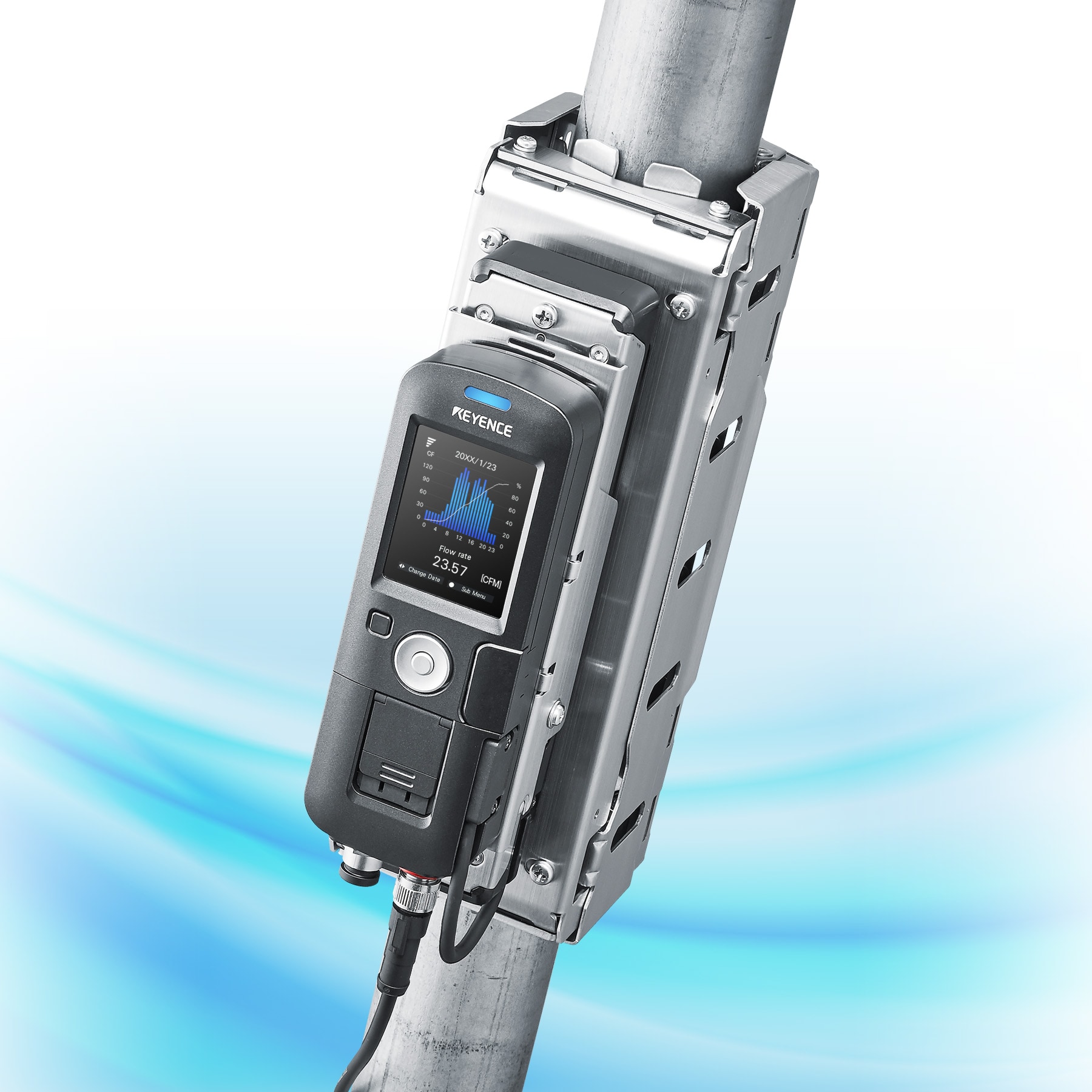
The reason air went unmetered is the same reason water did: inline flow meters are invasive. Cutting into a pressurized air line to install a sensor risks leaks, pressure loss, and downtime, so it rarely happens. Clamp-on air flow sensing removes that barrier. The sensor mounts on the outside of the tube or pipe and reads flow without breaking into the line, so there is no pressure loss, no clogging, no new leak path, and no need to shut the air off to install it.
Emergent Metering supplies and integrates the Keyence FD series for air. The FD-EC clamps onto pneumatic tubing from roughly 6 mm to 12.7 mm, which covers the drops and machine feeds where point-of-use consumption actually happens, and it installs without modifying the tube or interrupting the supply. For larger distribution lines, the FD series extends to bigger clamp-on gas and air models, so you can meter both the mains and the machine feeds with one approach. Every sensor reports continuously, and the readings feed a dashboard rather than a local gauge.
What the data reveals
The first time a plant meters its air, the findings are usually uncomfortable and valuable.
Leaks become visible. A metered line that keeps flowing when production has stopped is, almost by definition, leaking. Off-hours flow is the clearest leak signal there is, and you only see it when the air is measured.
Baseload waste shows up. Many plants discover the compressor is doing real work at 2 a.m. on a Sunday, feeding leaks and idle equipment, which is pure cost with no output.
Machine-level consumption becomes knowable. Metering individual drops shows which machines are the heavy users, whether one is consuming far more than its rated demand, which usually signals a problem, and whether a fix actually reduced usage.
Artificial demand gets exposed. When system pressure is set higher than it needs to be to mask a problem, every point of use draws more air than it should. Flow data at the machine makes that visible so pressure can be right-sized.
The ROI
Compressed air ROI is unusually clean because so much of the waste is both large and fixable. Finding and repairing the leaks that the Department of Energy says commonly run 20 to 30 percent of output goes straight to the power bill, because every cubic foot not leaked is a cubic foot the compressor does not have to make. Cutting off-hours baseload, right-sizing pressure, and catching a machine that has started over-consuming all land in the same place. And because the metering is continuous, the savings are verifiable: you can show the flow before and after a repair rather than hoping the next bill looks better. For many plants, the sensors pay back on the leak reduction alone.
Where air metering pays off first
Any plant that runs compressed air can benefit, but the return is largest where air is a major load and the system is old enough to have developed leaks and habits nobody tracks. Manufacturing and fabrication, food and beverage, plastics and packaging, and automotive suppliers all run air-heavy operations where a few metered drops quickly reveal where the money goes. The best first targets are the compressor discharge, so you can see total system flow against production, and the busiest machine feeds, where over-consumption and off-hours flow show up fastest. From there, coverage expands drop by drop as each measured line proves its worth. Because the sensors clamp on without a shutdown, you can start with the one or two lines most likely to be leaking and grow the program without ever interrupting production.
How Emergent Metering delivers it
We do more than sell the sensor. Emergent Metering scopes the air system, meters the mains and the drops that matter, installs the Keyence clamp-on sensors without shutting your air down, and integrates the flow data into one dashboard and, where you want it, your building management system over BACnet. Then we monitor it, so off-hours flow, a new leak, or a machine that has started over-drawing raises an alert instead of hiding in the data. The sensing hardware is Keyence. The metering program, integration, and ongoing monitoring are ours.
The takeaway
Compressed air is expensive to make, easy to waste, and, in most plants, completely unmeasured. Clamp-on flow sensing finally makes it visible without cutting a line or shutting anything down, and once you can see the air, the two biggest sources of waste, leaks and artificial demand, stop being invisible and start being fixable. Metering the air is usually the highest-return monitoring a plant can add, because the waste is already there and only the measurement was missing.
Find out what your air system is really costing you. Talk to a CEM or explore Managed Intelligence.
Flow-sensing hardware by Keyence; supply, integration, and ongoing monitoring by Emergent Metering.