Water is the one utility most facilities pay for twice, once at the meter and again in the losses they never see, and the reason is simple: almost nobody measures it past the building's main.
Why water goes unmeasured
The utility puts one meter at the property line and bills you for everything past it. What happens inside, which tenants use what, which processes drink the most, where a line is weeping behind a wall, is invisible unless you add metering of your own. That is exactly where most operators stop, because the traditional way to meter a branch line is disruptive. An inline or insertion meter has to go inside the pipe. That means cutting the line, draining it, threading in a fitting, and taking the system down while a plumber does the work. It introduces a new joint that can leak, a restriction that costs pressure, and a wetted sensor that fouls and needs maintenance. For a live building or a running process, the install alone is often enough to kill the project.
So the water stays unmetered, and the losses stay hidden.
Clamp-on flow sensing changes the install
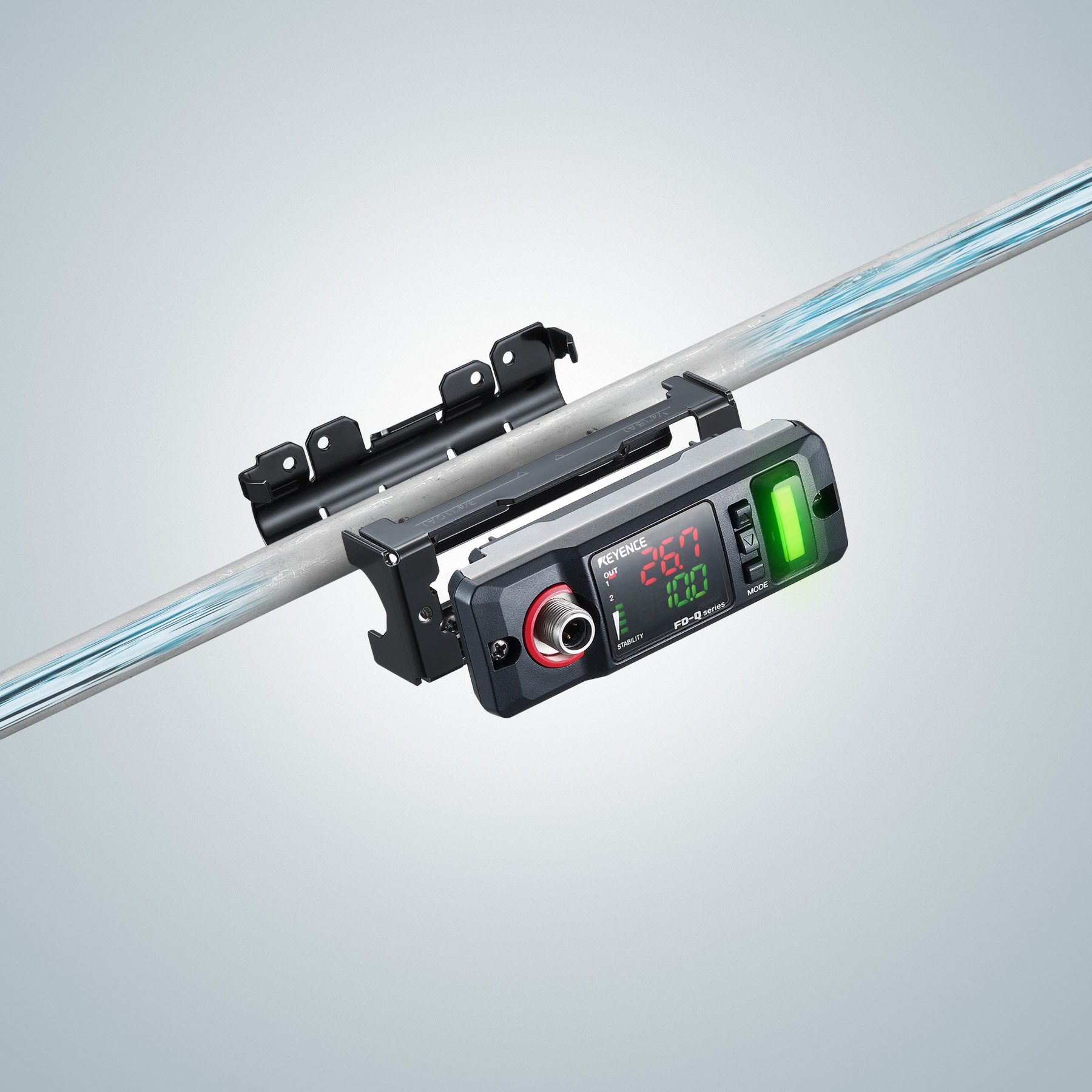
A clamp-on flow sensor does not go inside the pipe. It reads the flow through the pipe wall from the outside, so there is nothing wetted, nothing cut, and nothing to drain. You mount it on the existing line and it starts reporting. That single difference, measuring from outside instead of inside, removes every objection that keeps branch lines unmetered: no downtime, no pressure loss, no new leak path, no contamination risk, and no specialist plumbing.
The Keyence FD series for liquids
Emergent Metering supplies and integrates the Keyence FD series of clamp-on flow sensors, which are built precisely for this. The FD-Q mounts on the outside of a pipe in about sixty seconds with a screwdriver, with no pipe modification and no need to shut anything down. It reads virtually any liquid, including water, oils, chemicals, and process fluids, on both metal and resin pipe from roughly a quarter inch to two inches. Because it never touches the fluid, there is no pressure drop and nothing inside the line to clog or wear. For larger mains, the FD series extends to bigger clamp-on models, so a whole site can be covered by one family of sensors. And the sensors are not islands. Through the MU-N controller they speak industrial network protocols such as EtherNet/IP, so the readings flow into a dashboard, a building system, or an ERP rather than living on a local display.
That combination, a sixty-second non-invasive install plus real network output, is what turns water metering from a construction project into an afternoon.
What continuous water data lets you do
Once a branch line is measured continuously, several things become possible that a single utility meter can never deliver.
Tenant and department submetering becomes fair and defensible. Instead of allocating the water bill by square footage or a rough guess, you bill by actual use, with a time-stamped record behind every number. In multi-tenant commercial and multifamily property, that alone often justifies the sensors.
Leak detection gets early. A slow leak on a metered line shows up as flow that will not go to zero when it should, or a baseline that creeps up over weeks. Because water damage is cheap to fix early and brutal to fix late, catching that drift is where a clamp-on sensor pays for itself the first time.
Process and cooling water become accountable. Manufacturing lines, cooling loops, and wash-down systems all consume water that usually gets lumped into one bill. Metering them individually shows which process is heavy, whether a cooling tower is using more makeup water than it should, and where a change actually moved the number.
Sustainability reporting stops being an estimate. When water use is measured by line and logged continuously, the figures in an ESG or efficiency report come from data rather than from the back of an envelope.
Is clamp-on flow metering accurate enough to bill on?
It is a fair question, because measuring from outside the pipe sounds less precise than a meter sitting in the flow. In practice, modern clamp-on sensors are engineered for the accuracy that submetering and process monitoring require, and the trade is heavily in their favor: a non-contact measurement in exchange for no downtime, no pressure loss, no leak path, and no maintenance inside the line. For tenant submetering, leak detection, and process accountability, that is the right trade, and it is why clamp-on metering has become the default way to retrofit measurement onto lines that are already in service.
Where clamp-on water metering earns its place
The fit is broadest wherever water is either billed to someone else or consumed by a process that matters. Commercial real estate and multifamily operators use it for tenant submetering and leak protection. Manufacturers use it to hold process and cooling water accountable. Healthcare, food and beverage, and institutional campuses use it to meter the branches a single main can never separate. In every case the appeal is the same: coverage without a shutdown.
How Emergent Metering delivers it
Selling a sensor is the easy part. The value is in the metering program around it, and that is what we provide. Emergent Metering scopes which lines to meter for the outcome you are after, whether that is tenant billing, leak protection, or process accountability. We supply and install the Keyence clamp-on sensors, integrate the data into one dashboard and, where you want it, into your building management system over BACnet or your ERP, and we monitor the readings so a leak or an anomaly reaches a person instead of sitting in a log. The hardware is Keyence. The metering, integration, and ongoing visibility are ours.
The takeaway
The reason most facilities do not meter water past the main was never that the data was worthless. It was that the install was too disruptive to justify. Clamp-on flow sensing removes that barrier entirely: measurement from outside the pipe, mounted in about a minute, with no downtime and no maintenance inside the line. Once the branch lines are measured, water stops being a single mystery bill and becomes something you can bill fairly, protect against leaks, and actually manage.
See where clamp-on flow metering fits your facility. Talk to a CEM or explore Managed Intelligence.
Flow-sensing hardware by Keyence; supply, integration, and ongoing monitoring by Emergent Metering.