
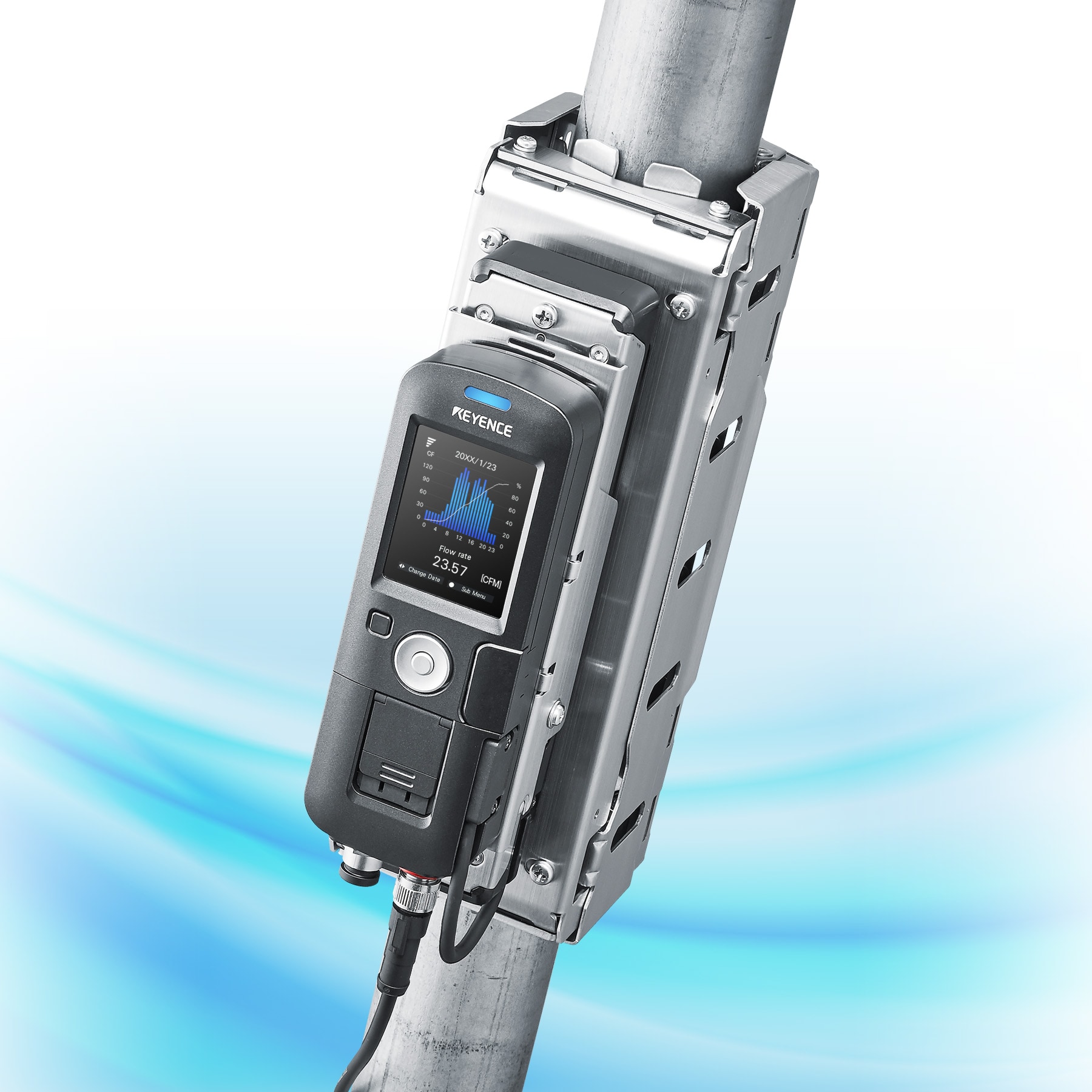
If you want to bill a tenant for water, prove a compressed air leak is costing you money, or watch a cooling loop for early signs of trouble, you need a flow meter. The first decision is not which brand to buy. It is which style of meter fits the pipe, the fluid, and the way you want to install it. That choice comes down to two families: clamp-on meters that mount on the outside of the pipe, and inline meters that become part of the pipe itself.
This guide walks through how each type works, where each one wins, and a simple way to decide. It pairs with our two deeper articles on clamp-on water metering and clamp-on compressed air metering, which go into the specifics of each application.
The two ways to measure flow
Every flow meter answers the same question: how much fluid is moving through this pipe right now, and how much has moved over time. The difference is where the sensor sits relative to the fluid.
An inline meter is plumbed into the line. The fluid passes directly through or across the sensing element, whether that element is a turbine, an orifice plate, a magnetic tube, a vortex shedder, or a thermal probe. A clamp-on meter never touches the fluid. It straps to the outside of the pipe and reads flow through the pipe wall, usually with ultrasonic sound waves that cross the stream and time how the flow speeds them up or slows them down.
That single distinction, inside the pipe versus outside the pipe, drives almost every practical trade-off that follows.
How clamp-on meters work
A clamp-on ultrasonic meter sends sound pulses at an angle through the pipe. Pulses traveling with the flow arrive a little sooner than pulses traveling against it, and the meter converts that tiny timing difference into a flow rate. Because the sensor sits on the surface, installation is a mechanical job, not a plumbing job. There is no cutting, no welding, no draining the system, and no shutdown. On many pipes a technician can mount the sensor and have a reading in minutes.
That non-invasive nature is the whole appeal. Nothing wetted means nothing to corrode, clog, or wear inside the stream, and nothing that adds a pressure drop to the line. Modern clamp-on sensors handle metal and resin pipe across a wide range of diameters, and they output to the same industrial networks a building system already speaks, so the reading lands on a dashboard rather than staying on a handheld.
The constraint is that a clamp-on meter has to hear cleanly through the wall. It wants a full pipe, a reasonably straight run before and after the sensor, and a wall material and thickness it can read through. Get those conditions right and accuracy is strong. Get them wrong, with a half-empty pipe or a sensor mounted right after an elbow, and the reading suffers.
How inline meters work
Inline meters have been the default for a century because putting the sensor in the fluid is the most direct way to measure it. A magnetic flow meter, for example, is extremely accurate on conductive liquids and is a common choice for permanent water and wastewater metering. Turbine, vortex, and Coriolis meters cover cases where you need mass flow, very high accuracy, or measurement of gases and steam that a clamp-on unit cannot always reach.
The cost of that directness is the install. An inline meter means cutting the pipe, fitting flanges or threads, sealing the connection, and pressure testing before you can turn the system back on. On a live building or a running production line, that often means scheduling downtime, which is exactly the disruption many facilities are trying to avoid. Once installed, a wetted sensor also sits in the path of whatever the fluid carries, so debris, scale, and corrosion become maintenance items over the life of the meter.
Where clamp-on wins
Clamp-on is usually the better answer when the install matters as much as the measurement. That covers a lot of real facility work.
Tenant and department submetering is a strong fit, because you can add a meter to an existing occupied line without a shutdown and start allocating cost right away. Leak detection and off-hours baseline monitoring fit too, since you are often adding meters to lines that were never designed to be opened. Temporary studies are almost purely a clamp-on job, because you can move a sensor from line to line to find where the water or air is actually going, then leave the permanent meters only where they pay off. And any line that cannot tolerate downtime, or any pipe you would rather not breach for corrosion or contamination reasons, points toward a sensor that stays on the outside.
Where inline still makes sense
Inline is not the old way to be replaced. It is the right tool for a different set of jobs. If you need the highest possible accuracy for custody transfer or regulated billing, a mass or magnetic meter may be the defensible choice. If the pipe is small, the fluid is difficult, or the line is often only partly full, an inline meter designed for that condition will outperform a clamp-on unit that struggles to hear through the wall. And when a system is already open, a new build or a scheduled retrofit, the install penalty disappears and inline becomes easy to justify.
A quick way to decide
Start with three questions. Can the line be shut down and opened without real cost? If not, lean clamp-on. Is the pipe full, straight enough at the sensor location, and made of a material the meter can read through? If yes, clamp-on is on the table. Does the application demand accuracy or a fluid type that only a wetted meter delivers, such as custody-grade billing or steam? If yes, inline earns its place.
Most facilities land on a mix. They use clamp-on meters to get visibility fast and everywhere, then reserve inline meters for the handful of points that need laboratory-grade numbers.
Water and compressed air are different problems
The two utilities where this decision comes up most often behave very differently. Water is dense, conductive, and usually fills the pipe, which makes it forgiving for both meter types and a natural place to start submetering without cutting anything. Compressed air is the opposite. It is expensive to produce, invisible when it leaks, and almost never measured, so the first meter you add tends to pay for itself just by exposing waste. Our companion pieces cover each case in detail: how clamp-on sensing meters water for billing and leak detection, and why compressed air is the utility most worth metering first.
How Emergent Metering delivers it
We do not sell you a meter and wish you luck. Emergent Metering scopes the line, picks the right sensing style for each point, installs it, connects the data to a dashboard your team actually reads, and keeps watching it. When clamp-on is the right call, you get visibility without a shutdown. When a line genuinely needs an inline meter, we say so and plan the work around your operations. The goal is the same either way: flow you can see, trust, and act on.
If you are weighing a metering project and are not sure which style fits your pipes, talk to us or explore how sensing fits into Managed Intelligence. A short conversation usually settles the clamp-on versus inline question faster than a spec sheet will.
Flow-sensing hardware by Keyence; supply, integration, and ongoing monitoring by Emergent Metering.